



Corneal Transplant
A corneal transplant is a surgical procedure in which the damaged part of the patient’s cornea is removed and replaced with a healthy cornea. This surgery is usually performed in the following cases:
- Improving vision in patients with corneal clouding and blurred vision.
- Repairing a corneal hole to protect the internal structure of the eye.
- Reducing severe pain caused by corneal diseases.
- Treating corneal infections that do not respond to medication.
Diseases treated with corneal transplant
Corneal edema after cataract surgery.
Keratoconus.
Corneal clouding or staining (usually due to herpes or bacterial infections of the eye).
Chemical burns of the cornea.
Inherited diseases that cause corneal clouding or swelling.
How is a corneal transplant obtained?
The corneas required for transplantation are obtained from donors after their death and stored in an eye bank. Before transplantation, these corneas are checked for health and the absence of diseases such as AIDS and hepatitis to prevent the transmission of the disease to the recipient.
Steps of corneal transplant surgery
1. The patient is admitted to the hospital and the necessary examinations are performed.
2. Coordination with the eye bank to provide a suitable cornea.
3. The patient is completely anesthetized during the operation.
4. Removing the damaged part of the cornea and replacing it with a healthy cornea.
5. Suturing the new cornea with fine surgical threads.
6. Eye dressing after the end of the surgery.
Duration of surgery: It usually takes between 1 and 2 hours. In some cases, other operations such as cataract or glaucoma may also be performed at the same time as this surgery.
Corneal transplantation is performed in various ways, including:
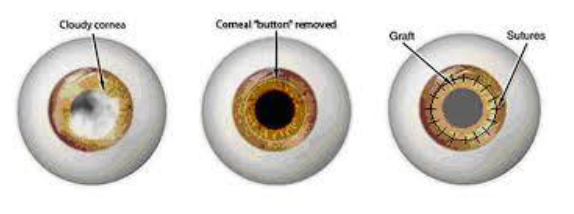
1- Lamellar transplantation (ALTK): In this method, only the superficial layer of the cornea that is damaged is removed and replaced with a healthy part.
2- Dalek transplantation (DALK): This method is used when there is damage in the superficial and middle layers of the cornea.
3- Desk transplantation (DSAEK): This method is used in patients whose only the endothelial layer of the cornea is affected. The thickness of the transplanted layer in this method is about 90 to 180 microns.
4- Demek transplantation (DMEK): The newest method of endothelial transplantation, in which a thin layer of 5 to 10 microns is replaced. This method requires high precision and skill.