


Cataract
Phaco cataract surgery
The clouding of the lens of the eye, which is naturally transparent, is called “cataract”. The only way to treat it is surgery, which is considered one of the most successful types of eye surgery.
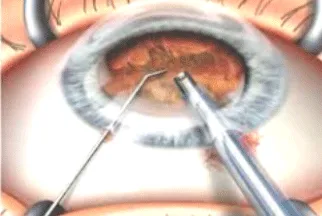
Today, Phaco is the best treatment for this disease. In this method, the lens of the eye is broken using ultrasonic waves and its particles are removed by a suction device. The lens capsule remains intact so that an artificial lens can be placed inside it.
This center provides these services professionally to the public by utilizing advanced Centurion, Constellation, Signature, and Infiniti devices, which are the new generation of Phaco machines.
Intracapsular cataract surgery
In this method, the lens is completely removed from the eye along with the surrounding capsule. As a result, it is not possible to implant an intraocular lens. This method has been almost abandoned today and is used only in special cases, such as partial dislocation of the lens where it is not possible to preserve the capsule.
Extracapsular cataract surgery
In this method, after opening the front part of the lens capsule, its contents are removed. In this case, the remaining capsule chamber is used to implant the lens. This technique is performed in two types:
1- Extracapsular method with large incision:
In this type, an incision of 9 to 11 mm is made in the limbus area. After removing the lens nucleus and washing out the remains, an intraocular lens is implanted and the incision site is closed with 6 to 9 stitches. The stitches are removed after 2 to 3 months. Therefore, it has a longer recovery period and may cause some astigmatism that needs to be corrected with glasses. Today, in most centers, this method has been replaced by a small incision type.
2- Extracapsular method with small incision:
In this method, an incision of about 3 mm is made and the nucleus of the lens inside the eye is crushed and removed through suction.
If both eyes have cataracts, the surgery is not performed at the same time. In the absence of emergency conditions, it is better to have a few weeks between the two operations.
In some patients with diabetes, cataract surgery is necessary to examine the retina and treat the lesions.
In terms of anesthesia, today, with the advancement of technology, surgery is performed with anesthetic drops or local injection without the need for general anesthesia. This method is especially suitable for patients with underlying diseases such as heart disease, diabetes, high blood pressure, and a history of stroke.
The duration of the surgery is usually about 10 minutes.